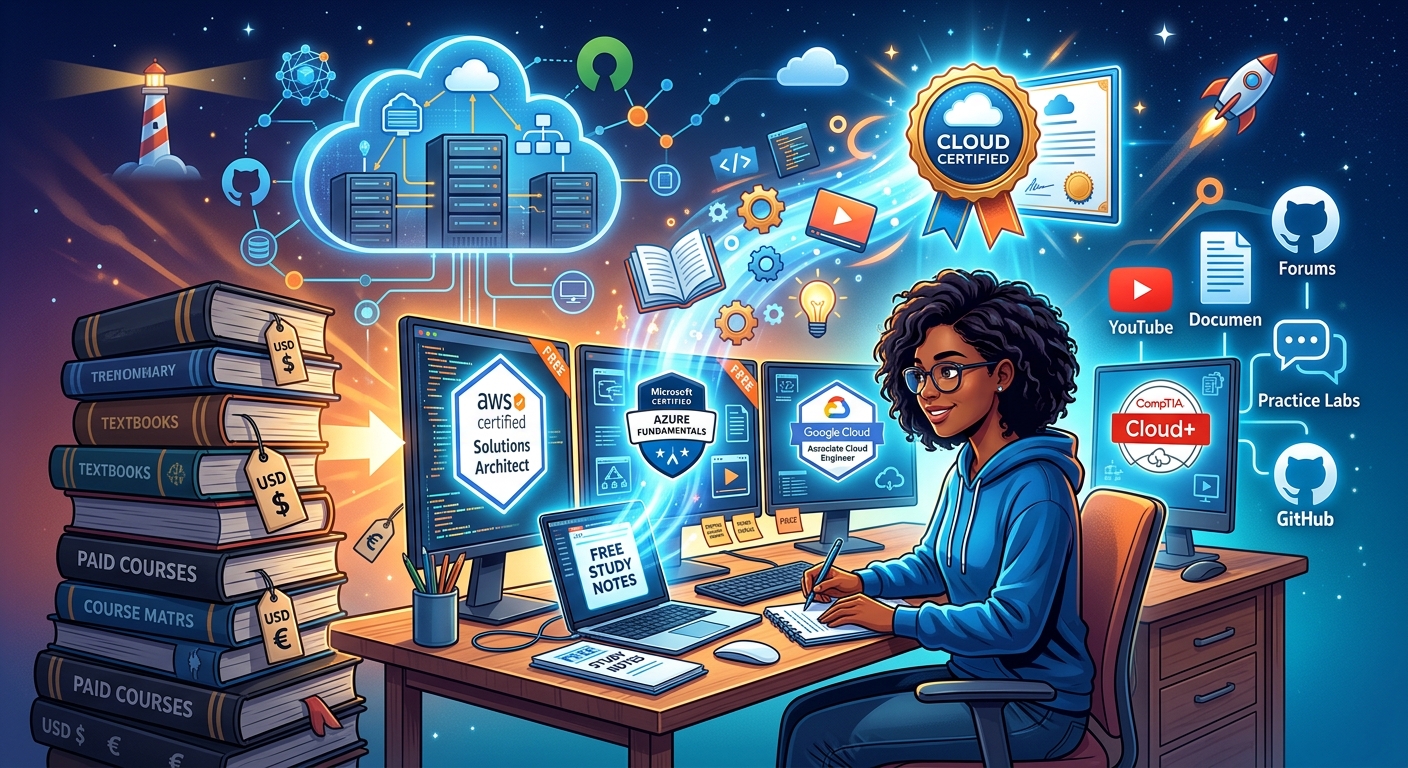
Paid certification courses can run $300 or more per seat, and the price keeps climbing as demand for cloud credentials grows. That cost barrier stops a lot of talented people before they even begin. AWS, Azure, and GCP publish genuinely high-quality learning content directly on their own platforms, and the community has built a parallel ecosystem of GitHub repos, YouTube series, and open practice banks that cover almost everything a paid course charges for. This guide maps a structured, cost-free study path across all three cloud providers, from your first read through official docs to the week before your exam.
A complete cloud certification study plan is achievable without spending a dollar on a paid course.
- Official documentation and free-tier sandbox environments from AWS, Azure, and GCP cover the vast majority of exam objectives.
- GitHub study repos and free YouTube tutorials fill every practical gap that official docs leave behind.
- A consistent weekly schedule built entirely from free tools produces better retention than a compressed paid course.
Official Documentation Is Your Study Syllabus
Each cloud provider publishes a detailed exam guide for every certification they offer. These documents list every domain, every task statement, and the percentage weighting each carries. Download the exam guide for your target certification first. Treat it as your curriculum. Every study session should map back to a specific line in that document.
AWS publishes hundreds of free digital training modules through its official training catalog on Skill Builder. That content is written by the teams that build the services, which means it stays current as those services change. Microsoft Learn organizes its free content into role-based learning paths with in-browser exercises. Google Cloud offers free lab access and quizzes through its own learning portal for candidates working through structured quests at their own pace.
None of these platforms are watered-down previews. They carry the same conceptual depth you find in paid courses, without the video narrative structure. Some learners find that narrative genuinely helpful. Most working professionals find that direct documentation study is faster and easier to fit into a packed daily schedule.
Free-Tier Accounts Build the Muscle Memory Exams Test
Reading about cloud architecture is useful. Actually building it in a live console is what makes the knowledge stick. Every major cloud provider offers free access to their platform, and the available services are enough to complete most exam-relevant configurations without spending a cent.
- AWS Free Tier includes 12 months of limited access to over 100 services, plus a set of services that remain free indefinitely, including AWS Lambda, Amazon S3 (5 GB), and Amazon DynamoDB (25 GB).
- Azure Free Account provides $200 in credit valid for 30 days and 12 months of access to popular services, covering virtual machines, blob storage, and managed database offerings.
- Google Cloud Free Tier gives $300 in credit for 90 days alongside always-free services that include Cloud Functions, Cloud Storage (5 GB), and BigQuery (1 TB of queries per month).
The strategy is to pair each documentation topic with a hands-on exercise in the console. Read about VPC peering, then configure it. Read about IAM policies, then write one. The exam will not walk you through UI steps, but it will test whether you understand what each configuration actually does. Nothing teaches that faster than doing it yourself.
GCP candidates get an additional advantage: the platform embeds free guided lab sandboxes directly inside its learning quests, which means you can run hands-on exercises without drawing down your own free-tier credit at all.
GitHub Study Repos Fill the Gaps Official Docs Leave Behind
Official documentation excels at explaining how individual services work. It is less effective at explaining how services connect in real-world architectures, how exam questions are framed, or which topics appear disproportionately on the actual test. The cloud certification community on GitHub fills that gap with freely shared study material that official channels simply do not provide.
- Community-maintained exam notes, organized by domain, consolidate hundreds of study hours into annotated summaries that highlight what actually matters on test day.
- Open-source architecture reference repos explain service behaviors with practical context and common gotchas that official documentation typically omits.
- Free practice question banks shared as plain text or JSON files give you exam-style questions you can run through without any subscription.
- Diagram collections in public repos help you visualize multi-service architectures before exam day, which is particularly valuable for associate-level exams that test architectural judgment rather than rote recall.
Search GitHub for your certification name alongside terms like "study guide," "exam notes," or "cheat sheet." Sort results by stars to surface the repos the community has validated. Check the commit history before relying on any single repo. An actively maintained repo updated in the last few months is worth far more than one with thousands of stars that has not been touched since the exam objectives changed.
Getting Deep Value from YouTube Tutorials
YouTube hosts some of the best cloud architecture content available anywhere, and most of it costs nothing. Channels run by AWS Heroes, Google Developer Experts, and Microsoft MVPs publish material that goes far beyond surface-level exam prep. You will find walkthroughs of real infrastructure scenarios, breakdowns of complex IAM policies, and multi-hour sessions on networking concepts that rival anything inside a paid course.
The challenge with long-form video is retention. A 90-minute architecture walkthrough is hard to review after the fact. You cannot search it, annotate it, or retrieve a specific explanation without scrubbing through the whole timeline again. A practical fix is to pull the transcript using a YouTube subtitle downloader before or after you watch. With the transcript saved locally, you can highlight key concepts, annotate sections that map to specific exam domains, and search for any term without touching the video again.
This technique is especially useful for architecture-focused sessions where a practitioner explains a multi-service design decision in passing. Those moments are easy to miss on a first watch and nearly impossible to retrieve later without hunting through a timestamp. A searchable, annotated transcript turns a dense video into a personal reference document you can return to throughout your study period.
A Weekly Study Schedule Built from Free Resources
Structure matters more than total hours. Working professionals who study for 45 focused minutes five days a week consistently retain more than those who compress everything into weekend blocks. The framework below uses only free resources and adapts to AWS, Azure, or GCP preparation without modification.
- Monday, domain review: Read the official exam guide section for the current week's domain. List every service and concept mentioned, even the ones that seem minor.
- Tuesday, documentation session: Work through official docs for each service in that domain. Write notes in your own words rather than copying definitions verbatim.
- Wednesday, hands-on lab: Build at least one configuration in your free-tier account that reflects what you read the previous day. Focus on the settings and parameters the documentation emphasized.
- Thursday, YouTube session: Find one or two practitioner tutorials covering the week's domain. Download transcripts for any video over 30 minutes and annotate them with your own observations.
- Friday, practice questions: Work through 20 to 30 free practice questions focused on the week's domain. Review every wrong answer against the official documentation, not just the provided explanation text.
- Weekend, GitHub review: Spend 30 minutes scanning community study notes for the week's topics and flag anything your own notes missed or explained differently.
This schedule covers a six-domain exam in roughly six weeks. Most associate-level certifications carry five to seven domains, which makes a seven to eight week study window realistic for candidates working full time alongside their preparation.
Finding Free Practice Tests to Gauge Readiness
Free practice questions are more available than most candidates expect. AWS includes official sample questions for every certification on its exam description pages. Microsoft Learn embeds knowledge checks inside most of its learning path modules. Google Cloud Skills Boost includes domain quizzes throughout its structured learning quests.
Beyond official sources, ExamTopics hosts community-contributed question sets for a wide range of certifications. Quality varies and some questions are outdated, so cross-reference any answer you are uncertain about against current official documentation. The goal of free practice questions is not to memorize correct answers. It is to identify which domains still have gaps before exam day, so remaining study time goes exactly where it will have the highest impact.
What Finishing an Exam Without a Paid Course Actually Proves
Passing a cloud certification through self-directed, free-resource study shows something a paid course cannot validate on its own. It demonstrates that you can locate authoritative information, construct a learning structure without external scaffolding, and sustain discipline across weeks of independent work. Those are skills that transfer directly into the role, where cloud documentation changes continuously and self-directed learning is a core professional requirement rather than a bonus trait.
Employers hiring for cloud roles are not checking which training platform you used. They are checking whether you passed and whether you can apply the concepts in a working environment. A free study path followed with consistency, paired with real hands-on sandbox practice, produces candidates who can satisfy both criteria.
The resources are already there. The exam guides, the documentation, the GitHub repos, the YouTube channels, and the free-tier accounts are all available right now. The only thing that converts them into a passing score is the schedule you commit to and keep.